Automated Dispensing Machine: How Fowa Medical Is Transforming Hospital Pharmacy Operations
Medication errors are a leading cause of preventable patient harm worldwide. According to the WHO Global Patient Safety Challenge: Medication Without Harm, medication-related harm costs an estimated US$42 billion annually — and most of it is avoidable.
In hospital pharmacies, the root cause is rarely incompetence. It’s fatigue. During peak hours, a single pharmacist may process hundreds of prescriptions, manually locating, counting, and verifying drugs among thousands of SKUs. Under sustained cognitive load, errors become statistically inevitable — not a question of “if,” but “when.”
This is where the automated dispensing machine comes in. It doesn’t replace pharmacists. It eliminates the repetitive, error-prone tasks that shouldn’t be done by humans in the first place — and lets pharmacists focus on what they’re trained for: clinical judgment, medication therapy management, and patient counseling.
In this guide, we break down how these systems work, compare the two dominant technologies, and present real-world performance data from one of China’s largest Tier-3 hospitals.
What Is an Automated Dispensing Machine?
An automated dispensing machine is a robotic system that automates the full medication distribution workflow — storage, retrieval, dispensing, and verification — with minimal human intervention. Unlike a simple vending cabinet, it integrates robotics, AI vision recognition, and prescription management software to handle the entire process from prescription receipt to final pharmacist check.
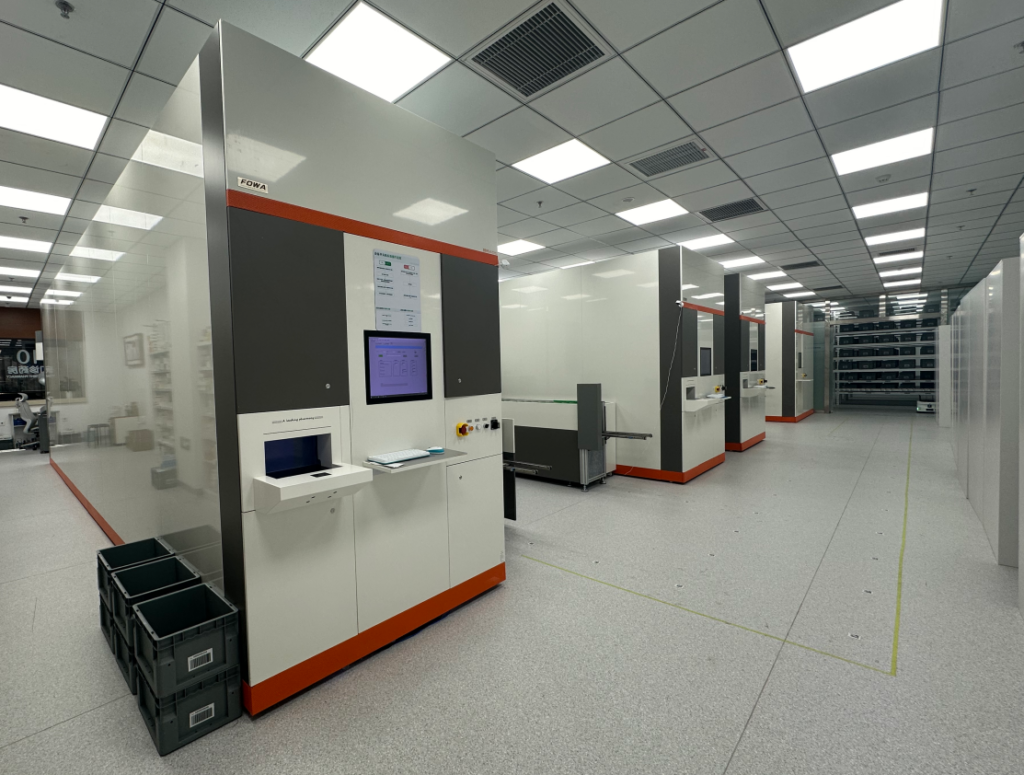
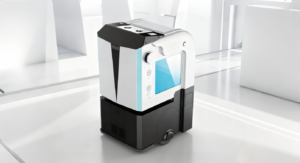
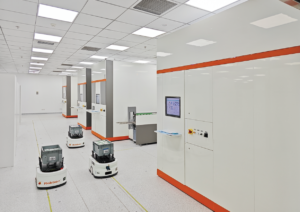
Fowa Medical has developed one of the most advanced systems in this category. Their Intelligent Drug Distribution and Storage System (RoboBox) uses dual robotic arms working in a pipeline mode, supported by 3D vision positioning and AI-based drug recognition. Combined with their secondary warehouse AGV robots, the system achieves 24-hour unattended auto-restocking — from inbound sorting to shelf replenishment to dispensing verification, the entire loop runs without human involvement.
How Does It Work? A 4-Step Walkthrough (automated dispensing machine)
The workflow is straightforward but technically sophisticated:
- Prescription Intake. After a patient pays, the prescription is transmitted in real time from the hospital’s HIS (Hospital Information System) to the dispensing machine.
- Robotic Retrieval. The system automatically locates the drug’s storage position. Dual robotic arms work in sequence — one retrieves the medication from the storage rack to a buffer zone, the other moves it from the buffer to the dispensing window. This pipeline design eliminates idle travel time.
- AI Vision Verification. Before the drug reaches the window, an AI vision system performs a second check — comparing the medication’s appearance, specifications, and quantity against the prescription. If anything is mismatched, the system flags it automatically.
- Pharmacist Final Check. The medication arrives at the window for the pharmacist’s final review before dispensing to the patient. This human-in-the-loop step is mandated by ISMP Guidelines for the Safe Use of Automated Dispensing Cabinets and remains non-negotiable.
The critical innovation is Step 3. Traditional systems rely on barcode scanning alone. Fowa Medical’s AI goes further — performing image-level recognition of the drug’s physical characteristics, not just a barcode match. This catches errors that barcode systems miss, such as wrong-strength look-alike packaging.
Robotic Arm vs. Chute-Type: Which Technology Should You Choose?(automated dispensing machine)
Not all automated dispensing machines are created equal. Two dominant technologies dominate the market, and the difference matters more than most buyers realize.
Chute-Type (Gravity-Fed) Systems
The earliest automated dispensing technology. Drugs are stored in tilted chutes and slide down by gravity to a dispensing outlet, where photoelectric sensors count them and mechanical baffles control the flow.
Strengths: Simple mechanics, lower upfront cost (¥800,000–1.2M per unit), easy maintenance.
Critical limitation: Drug specification coverage is only about 60%. Irregularly packaged medications — round bottles, soft tubes, odd-shaped boxes — can’t reliably slide down chutes and frequently jam. These 40% uncovered SKUs still require manual retrieval, which means pharmacists are still walking to shelves during peak hours.
Worse, restocking is entirely manual. Pharmacists must individually place drugs into chutes, a time-consuming process that makes overnight unattended replenishment impossible.
Dual Robotic Arm Systems
The newer, more capable approach. Robotic arms move between dense storage racks to precisely locate, grab, and transport medications on demand.
Fowa Medical’s RoboBox represents the state of the art: two arms operating in pipeline mode — one fetching from storage to buffer, the other delivering from buffer to window. Combined with the Intelligent Irregular Drug Storage and Dispensing Cabinet, the system achieves a 95% specification coverage rate, nearly eliminating manual fallback.
Side-by-Side Comparison
Dimension | Chute-Type | Dual Robotic Arm (Fowa RoboBox) |
Spec Coverage | ~60% | ~95% (with irregular cabinet) |
Dispensing Speed | 15–30 sec/prescription | Fastest 20 sec/prescription (parallel) |
Restocking | Manual | AGV auto-restocking + AI error correction, 24/7 unattended |
Concurrent Processing | Weak (physical bottleneck) | Strong (dual-arm pipeline) |
Storage Capacity | Medium (chute-limited) | High (~100,000 boxes, dense rack + vertical warehouse) |
Scalability | Low (adding chutes = adding floor space) | High (AGV + verification + secondary warehouse chain) |
Price Range | ¥800K–1.2M / unit | ¥1.8M–3M / unit |
The spec coverage gap is the most decisive factor. At 60% coverage, 40% of your drug catalog still requires manual handling — and those tend to be the most difficult, error-prone packages. The apparent cost savings of chute-type systems evaporate when you account for the ongoing labor required to manage the uncovered 40%.
Real-World Data: Beijing Anzhen Hospital Case Study
Specs and comparison tables are useful, but nothing beats actual operating data. Here’s what happened when Beijing Anzhen Hospital Tongzhou Campus deployed Fowa Medical’s full-chain system in October 2024.
Deployment Overview
- Scale: 10 robots operating 24/7 in a closed loop
- Storage: 1,350+ standard bin locations with traceable barcodes, holding ~100,000 drug boxes
- Chain: Secondary warehouse AGV → dense storage racks → dual-arm dispensing → AI verification → pharmacist check
One-Year Operating Results
Metric | Before | After | Change |
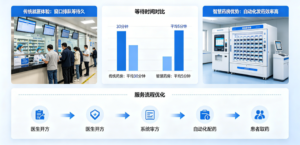
Single-prescription dispensing speed | Several minutes | Fastest 20 seconds | 3x+ improvement |
Average patient wait time | 30+ minutes | ~2 minutes | >90% reduction |
Dispensing error rate | Industry baseline | <0.01% | Near-zero |
Pharmacy manpower | Traditional staffing | 50% reduction | Major savings |
Inventory auditing | 3 days/month | Real-time automatic | 95% efficiency gain |
The project was featured on CCTV’s flagship news broadcast and subsequently covered by People’s Daily and Xinhua, making it a national benchmark for pharmacy automation in China.
Fowa Medical’s systems have also been deployed in community health centers and other primary care settings, demonstrating that the technology scales beyond large tertiary hospitals.
What Makes Fowa Medical Different?(automated dispensing machine)
Several companies build automated dispensing machines. Here’s what sets Fowa Medical apart:
1. Full-Stack In-House Development
Most vendors assemble systems from third-party components — robotic arms from one supplier, vision software from another, HIS integration from a third. Fowa Medical develops all core technologies in-house:
- Robotics: Self-developed dual-arm pharmacy robots with 3D vision positioning and AGV auto-restocking
- AI Algorithms: Drug visual recognition, prescription intelligent review, restocking error correction, and inventory AI prediction — all proprietary, not off-the-shelf modules
- Software + Integration: Pharmacy management software, IoT connectivity, and deep HIS integration delivered as one package
This matters because it eliminates the integration gaps, finger-pointing, and maintenance complexity that come with multi-vendor systems.
2. One-Stop Turnkey Delivery
Fowa Medical delivers hardware, software, IoT, and HIS integration as a single turnkey package. There’s no need to contract separate vendors for different system components, which dramatically reduces deployment risk and long-term maintenance burden.
3. Complete Product Portfolio
Beyond the flagship RoboBox, Fowa Medical offers a full product lineup to cover every pharmacy workflow:
ROI: What Hospital Administrators Need to Know
Let’s address the question every hospital CFO asks: “When does this pay for itself?”
Based on Fowa Medical’s deployment data at Tier-3 hospitals (500+ daily prescriptions), the economics look like this:
Traditional Pharmacy Annual Cost: ~¥1.12–1.45M/year (8–10 pharmacists, error handling, inventory management, expiration losses)
Full-Chain Automated System Annual Cost: ~¥1.25–1.43M/year (equipment amortization ¥600K/year, maintenance, 4–5 pharmacists, minimal error/loss costs)
Break-even: From Year 4 onward, the automated system’s annual cost drops below the traditional model.
5-Year Net ROI (Tier-3, dual-arm full-chain): Positive ¥3–5M, payback period 3–4 years.
The ROI calculation improves further when you factor in intangible benefits: reduced medication error liability, improved patient satisfaction scores, freed-up pharmacist time for clinical services, and real-time inventory visibility that cuts drug expiration losses.
How to Choose: A Practical Decision Framework(automated dispensing machine)
Not every hospital needs the most expensive system. Here’s a practical guide:
Tier-3 / Large General Hospitals (500+ daily prescriptions): Go with the dual-arm full-chain solution (RoboBox + AGV + verification cabinet). High prescription volume, complex drug catalogs, and zero-tolerance for errors make 95% spec coverage and 24/7 unattended restocking non-negotiable. Anything less and you’ll still have manual bottlenecks during peak hours.
Secondary / County-Level Hospitals (200–500 daily prescriptions): A single-arm system with an irregular drug cabinet is a viable starting point — but choose a platform with a clear upgrade path. Many hospitals that purchased chute-type systems found themselves unable to scale when prescription volumes grew, forcing a complete replacement within three years.
Community Health Centers (<200 daily prescriptions): A chute-type or compact single-arm system will suffice. The priority here is reliability and error reduction, not throughput.
Universal selection criteria regardless of size:
- Does the vendor have a Tier-3 hospital full-chain case with at least one year of operating data?
- Are the core robotics and AI algorithms developed in-house, or assembled from third-party parts?
- Is the system delivered as a turnkey package, or will you need to manage multiple vendor integrations?
- What is the spec coverage rate? (Below 85% means significant manual fallback)
The Bigger Picture: A Global Shift Toward Pharmacy Automation
Pharmacy automation is not a Chinese phenomenon — it’s a global trend with different regions at different stages.
The United States reached 97% pharmacy automation penetration by 2014. Canada hit 53% by 2010. China currently sits at approximately 20%, representing a 4–5x growth runway over the next decade. The Chinese pharmacy automation equipment market was valued at ~¥15 billion in 2023 and is projected to exceed ¥30 billion by 2026.
Globally, the WHO’s Medication Without Harm challenge aims to reduce severe, avoidable medication-related harm by 50% over five years. Automated dispensing technology is one of the most effective tools for achieving this goal — not by replacing pharmacists, but by removing the systemic conditions under which human error thrives.
Fowa Medical is positioning itself at the intersection of these trends: proven Tier-3 hospital technology, full-stack in-house development, and a product portfolio that scales from tertiary hospitals to community clinics. As the global healthcare industry moves toward zero-defect medication safety, the question for hospital leaders is no longer whether to automate — but which system to trust.
To learn more about Fowa Medical’s hospital pharmacy solutions or request a customized ROI assessment, visit fowamedical.com.(automated dispensing machine)